
05 Oct 2026
Over 23,000 young people in the South West have had their first MenB dose, but more than 53,000 are still missing out on the life-saving vaccine
UKHSA marks World Meningitis Day (5 October) with a call for young people across the South West, especially freshers, to get vaccinated against this devastating disease
As the world marks World Meningitis Day, UKHSA is urging young people across the South West, particularly freshers starting university this autumn, to come forward for a vaccine that could save their lives.
The warning follows UKHSA's first interim report on MenB vaccine coverage[1], published on Thursday 1 October, for the 2025/26 school year 13 cohort only (those born between 1 September 2007 and 31 August 2008) in the one-off vaccination offer targeting young adults in England.
The findings show coverage in the South West:
- was 30.7% (23,643 vaccinated out of 77,063 eligible individuals) up to 20 September 2026, ahead of the England average of 26.6%
- is gradually increasing as young adults have more time to be vaccinated (the report figures are for the first 9 weeks of the vaccination offer)
- varies substantially by ICB, sex, deprivation and ethnicity, with coverage ranging from 24.5% in Somerset to 33.7% in Bath and North East Somerset, Swindon and Wiltshire
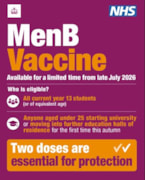
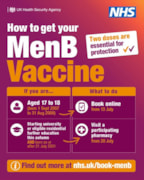
With over 53,000 eligible young people in the South West still unprotected, UKHSA is using World Meningitis Day to urge all those eligible, particularly freshers, to ensure they are protected with 2 doses as soon as possible. Two doses are essential for protection, with the doses needing to be administered at least 28 days apart. Students can get the vaccines from local pharmacies and can book via the NHS website: Book a MenB vaccination appointment - NHS.
Data show that young people starting at university are at increased risk of meningococcal disease due to social mixing patterns and other risk factors, with the risk for students in their first year of university around 7 times higher than young people of a similar age who do not go to university.
In addition, the recent bacterial genome sequencing study, which explained why the MenB outbreak in Kent in March was so severe, also crucially highlights the unpredictability of the bacteria. As highly invasive strains can emerge suddenly and unexpectedly, similar outbreaks could occur again.
The 3 outbreaks this year, in Kent, Dorset and Berkshire, tragically caused 3 deaths, and some of those who survived the infection are now facing lifelong health consequences. The Dorset outbreak is a stark reminder, closer to home for people across the South West, of the risks this disease poses.
In July 2026, a national one-off MenB vaccination offer was introduced for young adults, targeted at young people who were in school year 13 in the 2025 to 2026 academic year, and those aged under 25 who are starting university, or starting at some further education colleges and living at further education accommodation, for the first time in autumn 2026.
Dr Fiona Neely, Consultant in Health Protection, said:
"World Meningitis Day is an important reminder of just how devastating Meningitis B can be. The outbreaks in England earlier this year, including one in Dorset, tragically caused 3 deaths and left some who survived now facing lifelong health consequences. There is a particular risk for students in their first year of university, and with so many young people across the South West now settling into life at university or college, this message could not be more timely.
"Our recent genomics study also highlights how suddenly and unpredictably dangerous new strains of Meningitis B can emerge, such as the one seen in the Kent outbreak. This means similar outbreaks could occur again, anywhere, including here in the South West.
"The latest data shows coverage across our region is ahead of the national average, but with almost 7 in 10 eligible young people still not vaccinated, there is a lot more to do. The MenB vaccine offer for students and young people is underway, and it's vital everyone eligible gets two doses of the vaccine to be protected. Don't regret not getting vaccinated. Book in for yours now."
Coverage by ICB in the South West differed significantly from the lowest in Somerset at 24.5%, to the highest in Bath and North East Somerset, Swindon and Wiltshire at 33.7%.
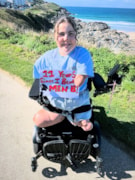
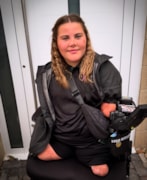
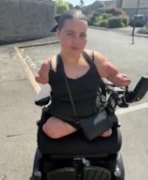
In 2014, Harmonie, from Bath, was just 10 months old, happy, and healthy, and had just taken her first steps, when what seemed like a common cold turned into meningococcal septicaemia within days. Harmonie got dramatically unwell, and a non-blanching rash appeared and spread across her body within hours, covering her from head to toe. She spent 4 weeks in intensive care fighting for her life. Harmonie survived but lost both her arms and both her legs to the disease. Speaking about her experience, Harmonie's mum Freya said:
"It started with what we thought was just a cold, and within a day Harmonie had gone from babbling and trying to climb out of her cot to a still and silent little baby. She was showing signs of a normal cold, but then a small purple mark appeared on her nose, and within minutes it had spread across her whole body. I knew straight away what it was. You always think it won't be you, but we thought that too. Meningitis moves so fast; it can take hold in hours, which is why it's so important that parents know the signs and act immediately if something feels wrong, even if your child has just been seen by a doctor. Harmonie is incredible; she swims, she does gymnastics, she goes to school, she dances, and she's won awards, but every day she has to find her own way of doing things that come easily to other children. Vaccination is one of the best defences we have against this disease, so if you or your child is eligible, please don't put it off; get protected today."
Dr Matthew Dominey, Public Health Consultant and Screening and Immunisation Lead for NHS England South West, said:
“Meningitis B can be life-threatening and, tragically, it can kill. The risk is higher for young people who are in their first year of university where close contact with lots of new people makes it easier for the bacteria to spread through everyday activities such as kissing, sharing drinks or vapes, and living together.
“This data shows that 30.7% of eligible people in the South West have now received one dose of the MenB vaccination, which is positive when compared with a national average of 26.6%.
“However, while it is encouraging that the South West is ahead, too many young people are still unprotected, and one dose is not the full course. Two doses, given at least four weeks apart, are needed for the best protection.
“Even if you have already started university or residential further education, it is not too late to come forward for your first dose. All eligible young people in England can book their first and second dose online through the NHS National Booking Service. Please do not leave it to chance – get protected.”
For more information on Meningococcal disease see: MenB vaccine for children - NHS; or for students to book or check eligibility for a vaccine see: Book a MenB vaccination appointment - NHS.
Further advice and support can be found at Meningitis in students - Information and advice
[1] Coverage is defined as the proportion of the eligible population that have been vaccinated with MenB during the one-off programme. This report measures cumulative coverage, so estimates include vaccinations given at any time after the start of the programme.
Contact Information
Lanvell Blake
lanvell.blake@ukhsa.gov.uk
Notes to editors
World Meningitis Day takes place on 5 October each year, raising global awareness of meningitis and septicaemia and encouraging vaccination, early recognition of symptoms and swift medical treatment.
UKHSA's first interim coverage report for the one-off MenB vaccination programme was published on 1 October 2026.
While the one-off MenB vaccine offer is available in England, Scotland, Wales, Northern Ireland and the Crown Dependencies (Jersey, Guernsey, and the Isle of Man), this report only looks at the data in England.
Further coverage reports will be published monthly for the duration of the programme and coverage of dose 2 will be assessed in future reports.
The cohorts eligible for the one-off MenB programme in England are:
- individuals born between 1 September 2007 and 31 August 2008
- individuals aged under 25, born on or after 21 July 2001 and starting at university as undergraduates for the first time in autumn 2026, or starting at some further education colleges for the first time in autumn 2026 and living at further education accommodation. This includes international students, and students from the devolved administrations and crown dependencies.
Timings of vaccination:
The one-off MenB vaccination offer consists of 2 doses administered at least 28 days apart. Eligible individuals were advised to receive their first dose as soon as possible, so that the majority of those eligible could receive their second doses, and therefore be fully protected before the start of the 2026/27 academic year.
Dose 1 will be offered until 31 December 2026, and dose 2 will be offered until 31 March 2027.
In England, the offer is being delivered in community pharmacies.
|
ICB Area |
Number eligible |
Number vaccinated dose 1 |
Coverage dose 1 (%)
|
|
NHS Bath and North East Somerset, Swindon and Wiltshire Integrated Care Board |
13,443 |
4,535 |
33.7 |
|
NHS Bristol, North Somerset and South Gloucestershire Integrated Care Board |
13,713 |
4,303 |
31.4 |
|
NHS Cornwall And the Isles of Scilly Integrated Care Board |
7,345 |
2,016 |
27.4 |
|
NHS Devon Integrated Care Board |
17,248 |
5,772 |
33.5 |
|
NHS Dorset Integrated Care Board |
9,578 |
2,606 |
27.2 |
|
NHS Gloucestershire Integrated Care Board |
8,427 |
2,619 |
31.1 |
|
NHS Somerset Integrated Care Board |
7,309 |
1,792 |
24.5 |
|
SOUTH WEST |
77,063 |
23,643 |
30.7 |
|
ENGLAND |
799,840 |
212,549 |
26.6 |

Powered by Onclusive PR Manager © 2026